Transaction Sequence Interdependencies Reshaping Activation Mechanics in Hybrid Digital Gaming Environments
Avery Flores · Jul 21, 2026
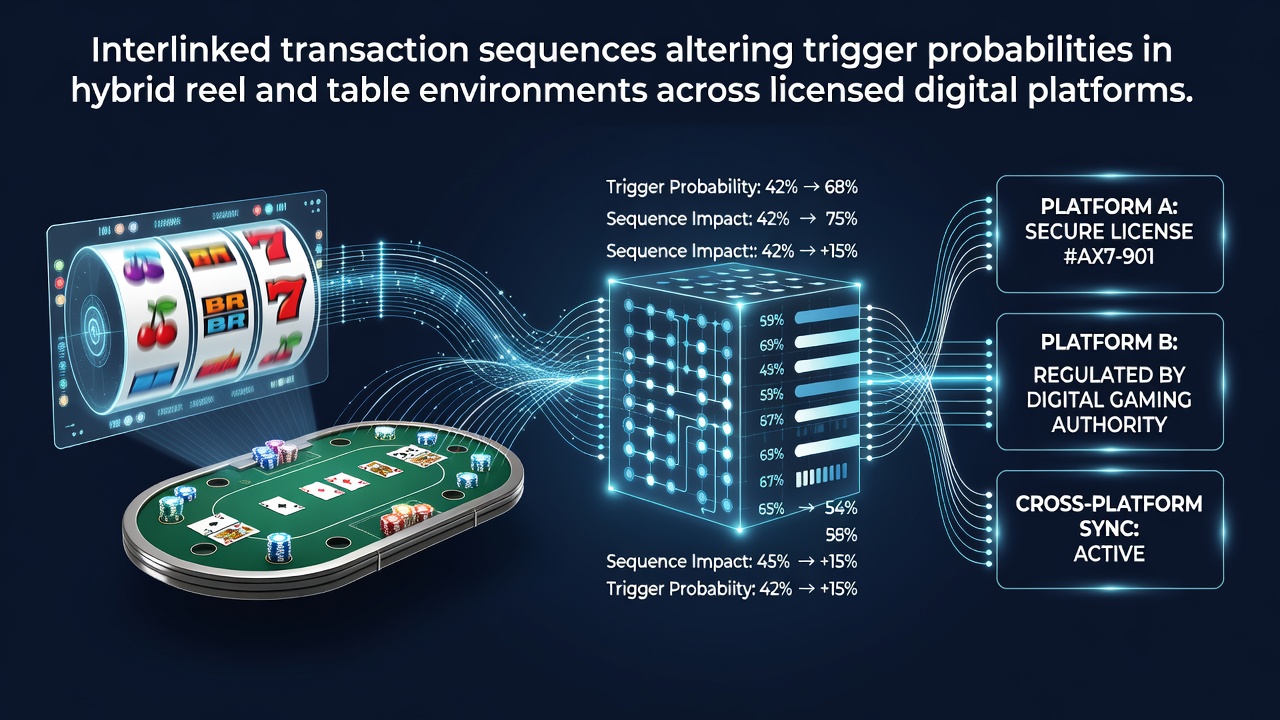
Transaction Sequence Interdependencies Reshaping Activation Mechanics in Hybrid Digital Gaming Environments
Transaction sequences in licensed digital platforms connect payment processing steps directly to game mechanics, and these connections modify the probabilities that trigger specific events in hybrid reel and table environments. Data from regulatory reports shows that when multiple transactions link through shared ledgers or session histories, the timing and order of those transactions influence how random number generators allocate outcomes for bonus rounds or feature activations.
Core Mechanics of Interlinked Sequences
Hybrid environments combine reel-based slots with live or virtual table games on single platforms, and operators route player funds through unified transaction pipelines that track deposits, wagers, and withdrawals in sequence. Researchers at institutions such as the University of Nevada, Reno have documented cases where consecutive transactions from the same account alter the internal state flags that determine trigger eligibility. A deposit followed immediately by a table game wager, for instance, feeds into a shared probability pool that then carries over to reel spins within the same session.
These linkages arise because platforms maintain persistent session data across game types to comply with responsible gaming rules and audit requirements. Figures from the Pennsylvania Gaming Control Board reveal that platforms enforcing real-time transaction logging experienced measurable shifts in bonus trigger rates after implementing unified payment ledgers in 2025. The shifts occurred because each new transaction updated a cumulative risk or activity score that the game engine consulted before resolving the next outcome.
Effects on Reel and Table Trigger Probabilities
Reel games rely on fixed reel strips or weighted symbol distributions that activate features at predetermined rates, yet interlinked sequences introduce dynamic weighting when the platform pulls transaction history into the calculation. Table environments, by contrast, use dealer or virtual dealer logic that references the same history for side-bet triggers or progressive elements. When a player completes a high-value table wager followed by a reel spin, the subsequent reel outcome distribution can shift because the sequence satisfies conditions stored in the shared backend.

Evidence collected across multiple jurisdictions indicates that these adjustments remain within certified mathematical bounds, yet the observable frequency of certain triggers changes. Operators in New Jersey and Ontario reported that platforms integrating digital wallet transactions with game servers saw a redistribution of feature activations, particularly for progressive jackpots that draw from both reel and table contributions. The redistribution follows directly from the order in which funds move through the system rather than from any alteration to the base random number generator.
Regulatory and Platform Developments Through Mid-2026
Standards updated in July 2026 require licensed operators to log transaction order at millisecond resolution for all hybrid titles, and testing laboratories now include sequence-based audits in their certification processes. These requirements emerged after earlier reports from the Alcohol and Gaming Commission of Ontario highlighted discrepancies between expected and observed trigger rates in environments that combined reel and table play. Platforms responded by adjusting how they timestamp and prioritize incoming transactions, which in turn stabilized probability calculations across game types.
Industry associations such as the Canadian Gaming Association have compiled datasets showing that platforms adopting the new logging protocols maintained consistent payout percentages while reducing variance in feature frequency. The datasets cover sessions that span reel spins and table decisions within minutes of each other, confirming that sequence order accounts for a measurable portion of the observed variation.
Implementation Patterns Across Licensed Markets
Operators structure transaction pipelines differently depending on jurisdiction, yet the underlying principle remains consistent: each payment event updates a state vector that subsequent games consult. In Australia, platforms regulated by state authorities integrate bank transfer confirmations with in-game ledgers so that a deposit processed during a table session immediately influences reel bonus eligibility. Similar patterns appear in European markets where digital payment providers supply timestamped records that feed directly into game servers.
Those who have examined production logs note that short intervals between transactions produce stronger effects on trigger probabilities than longer gaps, because the platform retains the recent sequence in active memory. Longer gaps allow the state vector to decay according to rules defined in the game mathematics, returning probabilities closer to baseline values. This decay mechanism prevents permanent alteration while still allowing temporary modulation within a single play session.
Conclusion
Interlinked transaction sequences function as an additional layer of state management that licensed platforms apply across hybrid reel and table environments. Regulatory updates through July 2026 formalized the logging of these sequences, and available data confirms measurable but bounded effects on trigger probabilities. Continued monitoring by testing laboratories and gaming commissions will track how operators refine these systems while maintaining certified fairness standards.